
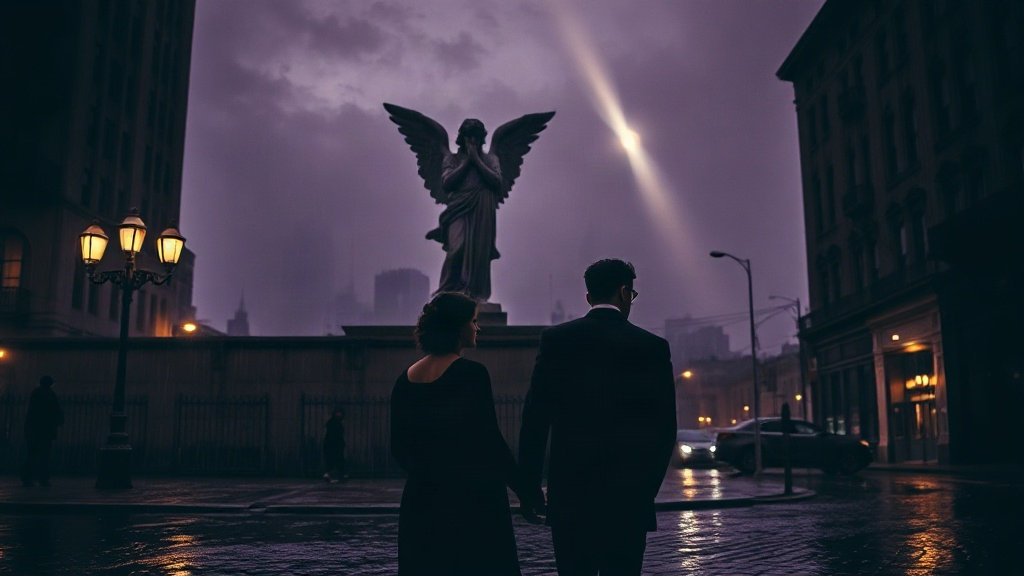
Some television endings fade. Others burrow in and stay. For a generation of Doctor Who fans, the farewell of Amy Pond and Rory Williams in "The Angels Take Manhattan" is the latter: an hour of television that, more than a decade after it first aired, still lands like a punch to the chest. The episode is often remembered for its weeping angels and its noir-soaked New York setting, but its real power lies elsewhere. It is, at heart, a love story, and one that understands something most adventure shows never quite grasp: that the most devastating endings are the ones that feel inevitable.
When the episode first broadcast, it closed a chapter that had run for two and a half seasons. Amy and Rory were not just companions; they were a married couple whose relationship had been tested by time travel, separations, and the kind of cosmic chaos that would wreck most marriages. Their exit was never going to be simple. What made it extraordinary was how the show chose to say goodbye.
A Farewell Written in Paradox
The plot mechanics of "The Angels Take Manhattan" are deceptively simple. The Weeping Angels have turned Manhattan into a hunting ground, sending victims back in time to live out their lives in the past. When Rory is touched by an angel, he is transported to the 1930s, and Amy faces an impossible choice: follow him into the past and never see the Doctor again, or stay and lose her husband forever. She chooses Rory. The Doctor cannot follow. The TARDIS cannot land in a fixed point in time that has already been read.
What elevates this from a clever sci-fi puzzle to genuine tragedy is the way the episode ties its mechanics to emotion. The central conceit is that a paradox can shatter a fixed point in time, and the Doctor and his companions exploit that to defeat the angels. But the same paradox that saves them also seals Amy and Rory's fate. They jump from a rooftop, creating a paradox that poisons the angels, and land in the past with no way back. The Doctor is left with a final, heartbreaking gift: a afterword written by Amy in a book, telling him not to come for them. It is a love letter and a goodbye in one.
Why the Ending Works
Many long-running shows fumble companion exits. Characters are killed off for shock value, or written out in ways that feel arbitrary. "The Angels Take Manhattan" avoids that trap by making the departure a direct consequence of who these people are. Amy and Rory have always chosen each other. Their relationship has survived the Doctor's absence, Rory's centuries as a Roman centurion, and the loss of their child. When Amy chooses to be with Rory in the past, it is not a sacrifice in the traditional sense. It is a continuation of the same choice she has made all along.
The episode also refuses to give the Doctor a clean resolution. He cannot save them. He cannot even visit. The final scene, in which he reads Amy's words in the TARDIS, is a masterclass in restrained grief. There is no grand speech, no last-minute reprieve. Just a man alone in a blue box, reading a farewell from the woman who once waited for him in a garden. It is quiet, and it is shattering.
The Love Story at the Center
At its core, "The Angels Take Manhattan" is a love story, and not just between Amy and Rory. It is also about the Doctor's love for them, and his inability to protect them from time itself. The episode understands that love is not about grand gestures but about the small, repeated choices we make. Amy and Rory's marriage is not perfect. They bicker, they doubt, they make mistakes. But they keep choosing each other. That is what makes their ending so moving.
The episode also gives Rory a rare moment of agency. Often the butt of jokes, he is the one who first realizes what the angels are doing and who insists on fighting back. His love for Amy is not passive; it is active, stubborn, and occasionally reckless. When he tells her to leave him and save herself, she refuses. It is a reversal of the classic damsel-in-distress trope, and it lands because we have seen their relationship grow over years of episodes.
In many ways, the episode is a perfect conclusion to the story that began in "The Eleventh Hour," when a little girl waited for a raggedy man to return. Amy spent her childhood waiting for the Doctor. In the end, she stops waiting and chooses a life with Rory. It is a coming-of-age moment for a character who was always defined by her relationship with the Doctor, and it gives her a final act of agency that feels earned.
The Role of New York
Setting the episode in New York is not incidental. The city becomes a character in its own right, a place of both romance and menace. The noir atmosphere, with its shadows and rain-slicked streets, gives the episode a cinematic quality that sets it apart from the typical Doctor Who adventure. The angels, silent and statuesque, blend perfectly into the urban landscape. They are everywhere and nowhere, a threat that cannot be reasoned with or outrun. The city's history, from the Brooklyn Bridge to the Winter Quay apartment building, becomes a trap. It is a place where time is not linear but layered, and where the past can reach out and snatch you.
New York also serves as a symbol of the American dream, a place where people go to start over. For Amy and Rory, it becomes the place where their story ends. They are not just lost in time; they are lost in a city that never stops moving. The episode uses the city's energy to heighten the sense of urgency, and its anonymity to underscore the finality of their separation. They will live out their lives in a place that is not home, with no way to tell the Doctor they are okay.
Why It Still Hurts
Fourteen years later, the episode's impact has not diminished. Part of that is due to the performances. Karen Gillan and Arthur Darvill had spent years building a believable relationship, and their final scenes together are raw and unguarded. Matt Smith, as the Doctor, conveys a grief that is all the more powerful for being restrained. He does not rage against the universe. He simply accepts, and that acceptance is devastating.
Another reason is the episode's refusal to offer false hope. The Doctor cannot find a loophole. He cannot bend the rules of time. The laws of the show's universe are consistent, and that consistency makes the loss feel real. Unlike many genre shows that resurrect characters or undo deaths, Doctor Who here respects its own stakes. Amy and Rory are gone, and they stay gone. That permanence is rare, and it is why the episode lingers.
The episode also benefits from its placement in the series arc. It is not just a companion exit; it is the end of an era. The Doctor has lost his best friends, and he is left alone. The final shot of him in the TARDIS, with Amy's afterword in hand, sets up the loneliness that would define the rest of his tenure. It is a turning point that gives the episode weight beyond its own story.
The Legacy of Amy and Rory
Amy and Rory changed the template for companions. They were not just sidekicks; they were a family. Their relationship was central to the show in a way that few others have been. They had a child, they got married, they grew old together (albeit off-screen). They were allowed to be flawed and complicated. Their exit was not just a goodbye to two characters but to a particular way of telling stories about love and time.
In the years since, Doctor Who has introduced many other companions, each with their own arcs and endings. But none have quite matched the emotional resonance of Amy and Rory's departure. That is not a knock on the others; it is a testament to how well this particular story was told. The episode is a reminder that science fiction can be as moving as any drama, and that a love story does not need to be realistic to feel true.
Frequently Asked Questions
Why did Amy and Rory have to leave Doctor Who?
Their departure was a creative decision to give the characters a definitive ending. Showrunner Steven Moffat wanted to conclude their story in a way that felt permanent and emotionally satisfying. The episode's time paradox provided a logical reason why the Doctor could never see them again.
Could the Doctor ever visit Amy and Rory in the past?
No. The episode establishes that the timeline in which they are trapped is a fixed point, and the TARDIS cannot land there without creating a catastrophic paradox. The Doctor respects this rule, which is why he does not attempt a rescue.
What is the significance of the afterword in the book?
The afterword, written by Amy, serves as a final message to the Doctor. It tells him not to come for them and to remember them as they were. It is a way for Amy to say goodbye on her own terms and to give the Doctor closure, even as he grieves.
How does 'The Angels Take Manhattan' compare to other companion exits?
It is often cited as one of the most emotional exits in the show's history. Unlike exits where companions are killed or simply decide to leave, this one combines tragedy with agency. Amy and Rory choose each other, and that choice is both heartbreaking and beautiful.
Does the episode have any lasting impact on the series?
Yes. It marks a turning point for the Eleventh Doctor, who becomes more withdrawn and melancholic. It also sets a high bar for companion departures, influencing how later exits were written and received.