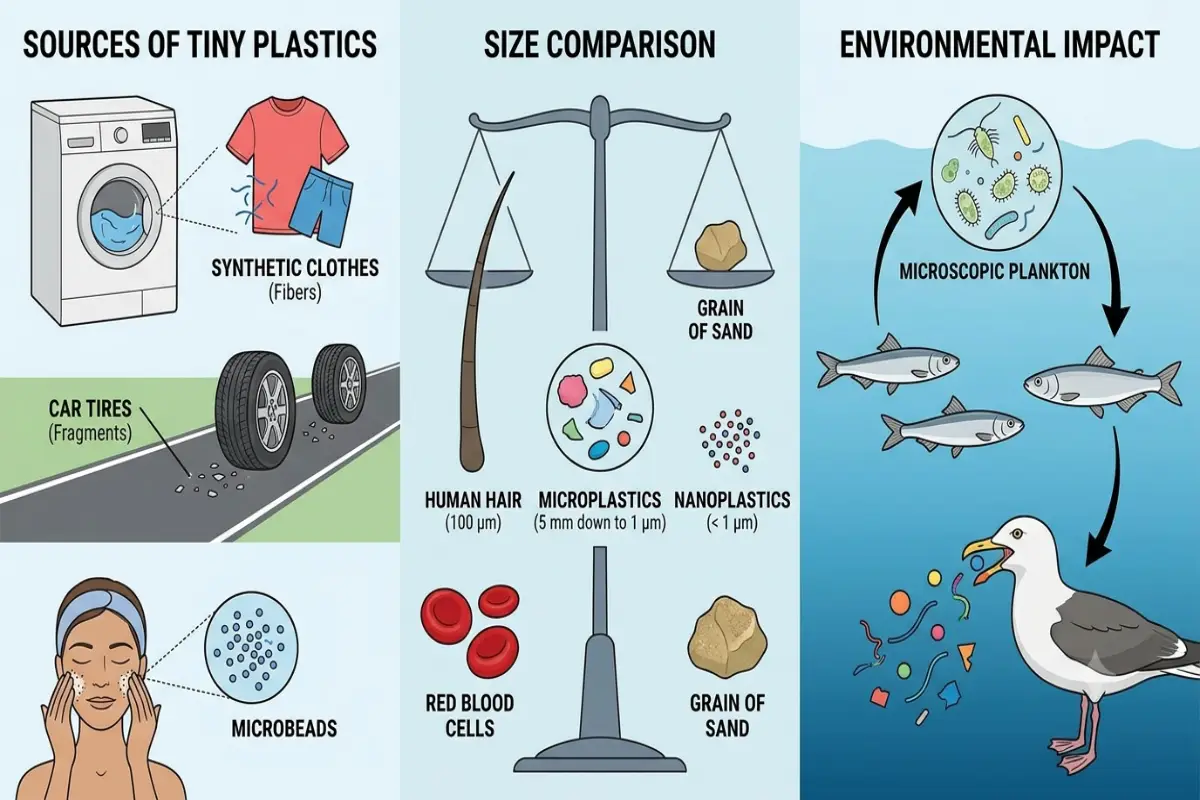
The pristine image of our planet's deep oceans and remote mountain peaks has shifted dramatically over the last few decades. Invisible to the naked eye, a quiet and persistent contaminant has infiltrated every corner of the global ecosystem, extending from the Marianas Trench to the falling snow in Antarctica. These minuscule synthetic fragments, commonly known as Tiny Plastics, represent one of the most complex environmental and public health challenges of the modern era. While larger debris like discarded water bottles and synthetic packaging are highly visible, these microscopic particles bypass standard filtration systems, entering our food chains, water supplies, and even the air we breathe without detection.
Addressing this ecological dilemma requires moving past surface-level awareness and investigating the deep science of synthetic degradation. For years, global discussions focused primarily on visible marine debris, but cutting-edge environmental research has shifted attention toward the invisible particles that accumulate in terrestrial soil and biological tissues. By examining how these particles form, how they migrate through global ecosystems, and how they interact with living organisms, society can develop robust, scientifically backed strategies to mitigate their long-term impact. True sustainability demands an analytical understanding of our synthetic footprint and an uncompromising commitment to structural material reform.
The Life Cycle and Secondary Formation of Microscopic Polymers
To understand the pervasive nature of these synthetic fragments, it is essential to distinguish between their primary production and secondary formation. Primary particles are manufactured intentionally at a microscopic scale, often utilized in industrial abrasive blasting, specialized cosmetics, and targeted medical applications. However, the overwhelming majority of particles found in global tracking studies are secondary in nature, resulting from the structural breakdown of larger consumer goods and industrial waste over extended periods.
When larger synthetic materials enter the environment, they are subjected to continuous mechanical forces and environmental weathering. Solar ultraviolet radiation initiates a process called photo-oxidation, breaking down the polymer chains and making the material brittle. Physical waves, wind resistance, and temperature fluctuations then shatter these brittle structures into smaller and smaller pieces. Because these materials are engineered for extreme durability, they do not biodegrade in the traditional sense; instead, they fragment indefinitely, maintaining their chemical integrity even as they shrink to sizes smaller than a single biological cell.
Ecosystem Infiltration and the Mechanics of Bioaccumulation
The structural smallness of these polymers allows them to easily cross traditional ecological boundaries, turning local waste issues into a global systemic problem. In agricultural environments, these fragments alter the structural integrity of the soil, disrupting moisture retention and negatively affecting beneficial organisms like earthworms. When soil health is compromised, agricultural productivity drops, and the synthetic particles can be absorbed by the root systems of food crops, entering human food networks at the foundational level.
In aquatic ecosystems, the problem intensifies through a process known as trophic transfer. Low-level organisms, such as zooplankton and small filter feeders, mistake the microscopic fragments for natural food sources. Because the material cannot be digested, it remains within the organism's digestive tract. When larger predatory fish consume these smaller organisms, they inherit the accumulated synthetic burden. As the process moves higher up the food web, the concentration of these polymers increases, eventually reaching top-tier predators and human consumers who rely on seafood as a primary protein source.
Chemical Hazards and Vector Capabilities
The threat posed by these synthetic fragments extends far beyond the physical blockages they can cause in biological digestive tracts. From a chemical perspective, these particles act like environmental sponges due to their hydrophobic surface properties. This means they naturally attract and bind to persistent organic pollutants present in surrounding waterways, including agricultural pesticides, industrial chemicals, and heavy metals, concentrating these dangerous toxins far above natural levels.
Furthermore, the manufacturing process of modern synthetics involves a wide array of chemical additives, such as plasticizers, flame retardants, and stabilizing agents. When these particles are ingested by living organisms, the internal biochemical environment can cause these hazardous additives to leach out directly into the host's tissues. This dual action—acting both as a transport vector for external environmental toxins and as a source of internal chemical leaching—creates a complex toxicological profile that researchers are working tirelessly to map and fully comprehend.
Actionable Strategies for Reducing Synthetic Footprints
Combating the spread of these hidden pollutants requires a combination of large-scale industrial innovation and intentional daily choices by individuals. While global regulatory frameworks take time to develop, there are immediate, practical steps that businesses and households can take to significantly curb the release of synthetic fragments into the local environment.
Upgrading Laundry Infrastructure
A massive volume of synthetic fibers enters the water system through the wastewater produced by domestic washing machines during the cleaning of polyester, nylon, and acrylic garments. Installing a high-efficiency external microfiber filter on your washing machine can capture up to ninety percent of these loose fibers before they exit into municipal sewers. Additionally, opting for liquid detergents over abrasive powders and washing clothes at lower temperatures reduces the mechanical friction that causes fabric breakdown.
Transitioning Away from Single-Use Polymers
Minimizing the demand for secondary particle generation starts with cutting off the source of bulk waste. Replacing single-use water bottles, grocery bags, and food containers with high-durability alternatives made from glass, stainless steel, or natural wood prevents the introduction of degradable materials into local ecosystems. Prioritizing products with minimal, plastic-free packaging sends a direct economic signal to manufacturers that sustainable design is a consumer priority.
Supporting Advanced Circular Economics
True structural change relies on moving away from a linear take-make-waste model toward a true circular economy. This means supporting industries that design products with their end-of-life cycle in mind, utilizing genuinely biodegradable materials or highly recyclable monomaterial structures. Proper sorting and disposal of existing synthetic waste ensure that old materials are safely reprocessed into long-term infrastructure rather than left to fragment in open landfills and rivers.
The Future of Material Science and Biodegradable Alternatives
Long-term mitigation depends heavily on the field of material science, where researchers are developing next-generation alternatives designed to replace traditional petroleum-based polymers. The goal is to create materials that provide the same strength, flexibility, and shelf-life as conventional options but break down completely into harmless organic compounds when exposed to natural soil or water microbes.
Biopolymers derived from agricultural waste, marine algae, and fungal mycelium are showing immense promise in industrial trials. Unlike traditional plastics that break down into persistent Tiny Plastics, these bio-based alternatives dissolve at a molecular level without leaving toxic residues behind. As scaling technologies improve and production costs drop, these sustainable materials are positioned to become the new standard across packaging, textiles, and consumer goods manufacturing worldwide.
Frequently Asked Questions
Can standard municipal water treatment plants filter out all microscopic plastics?
Modern wastewater treatment facilities are highly sophisticated and successfully trap a large percentage of larger synthetic debris through advanced settling tanks and sand filters. However, a significant portion of ultra-fine particles and nanofibers manage to slip through these conventional systems due to their incredibly small size and buoyancy, allowing them to enter natural river systems and eventually municipal drinking water networks.
How do synthetic microfibers detach from clothing during regular use?
Synthetic clothing items made from materials like fleece, polyester, and nylon are woven from thousands of individual synthetic threads. During a standard washing or drying cycle, the mechanical agitation, water pressure, and chemical action of detergents cause these delicate fibers to snap and shed. Millions of these microscopic threads are released per laundry load, making textile shedding one of the largest contributors to airborne and waterborne polymer pollution.
Are biological organisms capable of excreting ingested microparticles?
Larger organisms can often pass a portion of ingested synthetic particles through their digestive systems without immediate structural blockage, depending on the size and shape of the fragments. However, smaller particles, particularly those reaching the nanoscale, can translocate through the intestinal wall, entering the bloodstream and becoming trapped within internal organs, where excretion becomes mechanically impossible.
What role does solar radiation play in creating these environmental fragments?
Solar ultraviolet radiation is a primary driver of secondary particle formation. When bulk synthetic debris is exposed to sunlight, the high-energy UV rays break the carbon-carbon bonds within the polymer matrix. This process, known as photo-degradation, makes the material structural weak and brittle, leaving it highly susceptible to shattering into millions of microscopic pieces under the influence of wind, rain, and physical impact.
Addressing the hidden crisis of global polymer accumulation requires an analytical mindset, persistent research, and a shared responsibility across all sectors of society. Understanding the origins and migration patterns of Tiny Plastics empowers us to make better material choices and advocate for the scientific advancements necessary to preserve our natural world. Here at Major Daily, we are dedicated to bringing objective, data-driven insights to the forefront of environmental science and technology discussions. Take a closer look at your material dependencies today, support circular economic initiatives, and join the global movement toward a cleaner, more resilient, and truly sustainable future.