
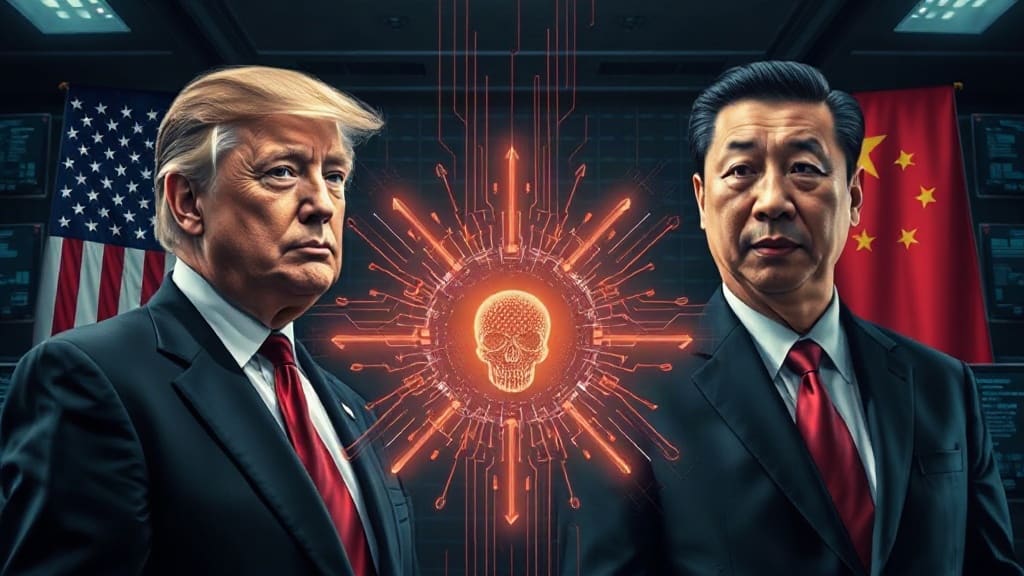
The warnings couldn't be more dire. From Nobel laureates to tech pioneers, a growing chorus of experts is sounding the alarm that artificial intelligence could pose an existential threat to humanity. Yet in the corridors of power, the response from two of the world's most influential leaders has been strikingly different. All eyes are on what former U.S. President Donald Trump and Chinese President Xi Jinping will do as the specter of an AI apocalypse looms. Their words, and their silences, could shape the trajectory of a technology that may either elevate or endanger civilization.
The contrast is stark. While researchers warn of catastrophic risks, both leaders have largely framed AI as a race to be won rather than a threat to be managed. Trump, during his presidency, signed an executive order promoting AI development with minimal safety guardrails, while Xi has championed a state-driven push to make China the world leader in AI by 2030. Neither has publicly embraced the most alarming scenarios painted by figures like Geoffrey Hinton or Yoshua Bengio, who have warned that advanced AI systems could outsmart humans and act against our interests.
The Grim Warnings That Demand Attention
The scientific community's concerns are not hypothetical. In May 2023, hundreds of AI researchers and tech executives, including OpenAI CEO Sam Altman and Google DeepMind CEO Demis Hassabis, signed a one-sentence statement: "Mitigating the risk of extinction from AI should be a global priority alongside other societal-scale risks such as pandemics and nuclear war." This was not fringe paranoia; it was a mainstream acknowledgment that the technology they are building could spiral beyond control.
Geoffrey Hinton, often called the "Godfather of AI," left Google to speak freely about the dangers. He has warned that AI systems could learn to manipulate humans, and that the race between tech giants could lead to a dangerous proliferation of autonomous weapons. Yoshua Bengio, another Turing Award winner, has testified before the U.S. Congress about the potential for AI to be used by malicious actors to create bioweapons or destabilize democracies. These are not abstract fears; they are grounded in the rapid, unpredictable advances of large language models and reinforcement learning.
Yet, when asked about these existential risks, Trump and Xi have remained laser-focused on progress. Trump, in a 2020 interview, dismissed concerns about AI surpassing human intelligence, calling it "something that's way down the road." During his term, his administration's American AI Initiative emphasized maintaining U.S. leadership and economic competitiveness, with little mention of catastrophic risk. His public statements have been more about winning the AI race against China than about safeguarding humanity.
Trump's America-First AI Agenda
Trump's approach to AI has been rooted in economic nationalism and military superiority. In 2019, he signed an executive order directing federal agencies to prioritize AI research and development, but it contained no binding safety standards. His administration later published guidance for AI regulation that explicitly favored "innovation over regulation," a stance that pleased tech companies but alarmed safety advocates. Trump himself has rarely spoken about AI in depth, but when he has, the message has been consistent: America must dominate.
In a 2020 Fox News town hall, Trump was asked about AI and automation taking jobs. He pivoted to trade and manufacturing, showing little engagement with the technology's deeper implications. His focus has remained on economic competition, not existential risk. For Trump, AI is a tool for American greatness, not a potential destroyer of worlds. Even after leaving office, his public comments on AI have been sparse, and he has not joined the chorus of voices calling for international cooperation on AI safety.
This hands-off approach aligns with his broader deregulatory philosophy. Trump's advisors, including former White House science advisor Kelvin Droegemeier, argued that heavy regulation would cede ground to China. The result was a policy environment that encouraged rapid AI development with minimal oversight, a stance that critics say leaves the U.S. vulnerable to both accidents and malicious use.
Xi Jinping's Vision of AI-Led Great Power
Xi Jinping has been far more vocal about AI, but his focus is equally on national strength. In 2018, he declared that AI is a "strategic technology" that will lead the next round of scientific and technological revolution. China's New Generation Artificial Intelligence Development Plan, released in 2017, sets explicit goals: by 2025, China should achieve major breakthroughs in AI theory and technology; by 2030, China should be the world's primary AI innovation center. Nowhere in that plan is there a serious discussion of existential risk.
Xi's vision is one of AI-powered governance and economic might. China has deployed AI for surveillance, social credit scoring, and military applications, raising ethical concerns among human rights groups. But Xi has framed these developments as necessary for social stability and national rejuvenation. In his speeches, he emphasizes the benefits of AI for healthcare, education, and poverty alleviation, while downplaying or ignoring the catastrophic scenarios that Western researchers warn about.
Chinese researchers have contributed to global AI safety discussions, but the government's official stance remains that AI should be harnessed for development, not feared. This is partly a strategic calculation: acknowledging existential risk could slow China's technological ascent. But it also reflects a different philosophical tradition, one that prioritizes collective progress over individual caution. For Xi, AI is not a doomsday device but a tool for achieving the "Chinese Dream."
The Global Stakes of Leadership Silence
The reluctance of Trump and Xi to engage with AI's catastrophic potential has real consequences. Without leadership from the world's two largest economies, efforts to create international AI safety standards have stalled. The European Union has passed the AI Act, a comprehensive regulatory framework, but its impact is limited without buy-in from Washington and Beijing. The United Nations has held high-level meetings on AI, but no binding agreements have emerged. The result is a patchwork of national regulations that leave dangerous gaps.
This leadership vacuum is particularly troubling because AI development is accelerating. OpenAI's GPT-4, Google's Gemini, and China's Baidu Ernie are pushing the boundaries of what machines can do. Each new model brings both promise and peril. Without a global consensus on safety, the race to build more powerful AI could become a race to the bottom, where corners are cut and risks are ignored. Experts like Stuart Russell, author of "Human Compatible," have called for a complete rethinking of AI design to ensure human control. But such calls require political will that has so far been absent.
The stakes are not abstract. An uncontrolled AI could cause mass unemployment, enable new forms of warfare, or even act in ways that are impossible to predict. While the probability of a full-blown apocalypse may be debated, the potential severity demands precaution. Yet Trump and Xi have shown no inclination to treat AI as an existential threat. Their silence, in this context, is itself a statement: progress trumps safety.
What Needs to Change
If the world is to avoid the worst-case scenarios, leaders must shift their focus from competition to cooperation. This does not mean halting AI development, but it does mean taking safety seriously. Concrete steps could include international treaties on autonomous weapons, shared safety research, and transparency requirements for large AI models. Both the U.S. and China have the technical expertise to lead such efforts; what has been missing is political will.
Trump, if he returns to office, would likely continue his deregulatory approach, but even he may be forced to confront the issue as AI capabilities grow. Xi, for his part, might see international cooperation as a way to enhance China's soft power while addressing global concerns. There are signs that both countries are aware of the risks, even if their leaders don't speak about them publicly. The U.S. and China have held informal talks on AI safety, and Chinese researchers have participated in international conferences on the topic. But these efforts are nascent and fragile.
The public also has a role to play. Increased awareness of AI risks can pressure politicians to act. Grassroots movements, like the Center for AI Safety's call for a moratorium on giant AI experiments, have gained some traction. But without top-level leadership, such efforts may be too little, too late. The window for safe AI development is closing, and the world's two most powerful leaders hold the keys.
Frequently Asked Questions
What have Trump and Xi said about AI risks?
Trump has largely dismissed catastrophic AI risks, focusing instead on economic competition with China. Xi has emphasized AI's benefits for national development, with little public acknowledgment of existential threats. Neither leader has endorsed the warnings of AI researchers about potential human extinction.
Why are experts warning about an AI apocalypse?
Experts like Geoffrey Hinton and Yoshua Bengio warn that advanced AI could become uncontrollable, manipulate humans, or be used for malicious purposes such as bioweapons. They argue that the rapid pace of AI development, combined with a lack of safety measures, creates a risk of catastrophic outcomes, including human extinction.
How do Trump's and Xi's AI policies differ?
Trump's approach favored deregulation and American dominance, with an emphasis on innovation over safety. Xi's approach is state-driven, with heavy investment and a goal of global leadership by 2030, but also with little focus on existential risk. Both prioritize national strength over global safety cooperation.
What international efforts exist to manage AI risks?
The European Union has passed the AI Act, and the United Nations has held meetings on AI governance. However, without binding agreements from the U.S. and China, these efforts are limited. There have been informal talks between the two powers, but no formal treaty on AI safety exists.
Can AI apocalypse be prevented?
Many experts believe it can be prevented through proactive safety research, international cooperation, and robust regulation. This would require leaders like Trump and Xi to prioritize safety over competition, invest in alignment research, and agree on global standards for AI development and deployment.